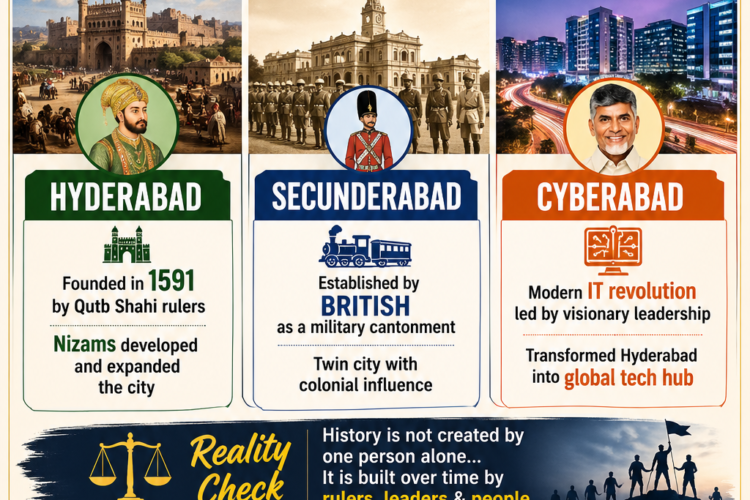
Hyderabad’s Evolution: Fact vs Claim – Who Really Built the City?
Hyderabad: A popular statement often circulates in political and social discussions — “Nizam created Hyderabad, British created Secunderabad, Chandrababu Naidu created Cyberabad.”While this sounds catchy, the historical reality is far more layered and nuanced.🏛️ The Origins of HyderabadThe city of Hyderabad was founded in 1591 by Muhammad Quli Qutb Shah, a ruler of the Qutb Shahi dynasty.Strategically located near the Musi River, Hyderabad was envisioned as a grand city with iconic structures like Charminar symbolizing its foundation.Later, the Asaf Jahi dynasty, popularly known as the Nizams, ruled the region for nearly two centuries. During their reign, the city saw significant advancements in:Urban planningEducation institutionsHealthcare systemsCultural developmentConclusion:While the Nizams played a crucial role in shaping Hyderabad, they were not its original founders.🏛️ The Emergence of SecunderabadThe twin city of Secunderabad came into existence during the early 19th century.It was established as a British cantonment by the British East India Company and named after Sikandar Jah.Secunderabad developed with a distinct colonial character, featuring:Military infrastructureRailway connectivityEuropean-style urban layoutsConclusion:The British indeed played a primary role in developing Secunderabad as a military and administrative hub.💻 Rise of Cyberabad – The IT RevolutionIn the late 1990s and early 2000s, Hyderabad witnessed a technological transformation under the leadership of N. Chandrababu Naidu.With initiatives such as:Development of HITEC CityExpansion of GachibowliAttraction of global IT companiesThe western corridor of Hyderabad evolved into what is popularly known as “Cyberabad.”This transformation positioned Hyderabad as a global IT destination.Conclusion:While Cyberabad was not “created” by a single individual, Chandrababu Naidu’s policies and vision significantly accelerated its growth.⚖️ Fact vs Claim – A Balanced PerspectiveThe popular statement simplifies centuries of history into a few lines. However, experts emphasize that:Cities evolve through collective contributions over timeMultiple rulers, governments, and citizens shape urban growthPolitical narratives often compress history for impact🧠 Expert ViewUrban historians argue that Hyderabad’s journey is a reflection of:Medieval planning (Qutb Shahi era)Royal patronage (Nizam period)Colonial influence (British era)Modern economic reforms (post-1990s leadership)🏁 Final WordHyderabad, Secunderabad, and Cyberabad are not creations of isolated individuals but outcomes of centuries of evolution, governance, and vision.Understanding this layered history helps citizens appreciate both heritage and development without oversimplification.🏢 About UsMy Tolet India – Property Services in South IndiaProviding trusted solutions for:BuyingSellingRentingCommercial & Residential Properties