Union Budget 2026-27: India’s Bold Push for Capex, Manufacturing, and Inclusive Growth
New Delhi, 1 February 2026 — Finance Minister Nirmala Sitharaman today delivered her ninth consecutive Union Budget, setting an ambitious economic agenda for the fiscal year 2026-27. The Budget — grounded in the government’s “three Kartavya” philosophy of accelerating growth, enhancing competitiveness, and ensuring inclusive development — reinforces India’s infrastructure-led strategy while emphasizing manufacturing, technological self-reliance and fiscal discipline.
📊 1. Economic Outlook & Fiscal Roadmap
The headline focus of Budget 2026-27 is sustaining India’s growth momentum amid a volatile global backdrop. While official GDP projections vary across sources, policymakers emphasize robust activity powered by capital creation, strategic industry support and an optimized fiscal stance.
Fiscal priorities include:
Fiscal deficit target of ~4.3% of GDP in FY27.
Record capital expenditure raised to ₹12.2 lakh crore, nearly a 9% increase over the previous year, underscoring public investment as the engine of growth.
This combination of infrastructure stimulus and fiscal prudence aims to balance short-term support with long-term sustainability.
🚆 2. Infrastructure: Connectivity & Urban Growth
Infrastructure remains the centerpiece of Budget 2026.
🚄 High-Speed Rail Corridors
The government unveiled plans for seven new high-speed rail corridors, linking major economic nodes such as Mumbai–Pune, Pune–Hyderabad, Hyderabad–Bengaluru, Delhi–Varanasi, and others. These corridors are designed to transform regional connectivity and lower carbon intensity in travel.
🚢 Freight, Waterways, and Logistic Networks
A Dedicated East-West Freight Corridor between Dankuni and Surat aims to unclog logistics bottlenecks.
20 new National Waterways are being operationalized to boost inland and coastal cargo movement.

A Coastal Cargo Promotion Scheme has been launched to shift freight from road to cost-effective maritime routes.
🏙️ City Economic Regions
The Budget introduced the concept of City Economic Regions in Tier 2 and Tier 3 cities — integrating transport, logistics, housing, and industry to create balanced urban growth.
🏭 3. Manufacturing & Strategic Industries
The Budget signals a full-throttle push to industrialize India’s manufacturing base and reduce reliance on imports.
💡 Semiconductors & Electronics
India Semiconductor Mission 2.0 received an enhanced outlay of ₹40,000 crore to boost chip manufacturing, design IP development, and technology ecosystems.
Additional support was announced for electronics components and equipment manufacturing, including new cluster-based initiatives.
🧪 Biopharma SHAKTI & Chemical Parks
A ₹10,000 crore Biopharma SHAKTI programme will build India’s pharmaceutical production strengths and global competitiveness.
Three new chemical parks and container manufacturing hubs are to be established through a plug-and-play model to attract investment and accelerate industrial activity.
🧱 Rare Earth Minerals & Textiles
Dedicated rare earth corridors have been announced for states such as Odisha, Kerala, Andhra Pradesh, and Tamil Nadu — critical for high-tech supply chains.
Mega textile parks are planned to make India a global leader in textiles and technical fabrics.
💰 4. Taxation, Compliance & Market Reforms
The Budget blends tax reform with compliance ease to support taxpayers and deepen markets.
📉 Tax Compliance & Incentives
The government introduced simplified compliance procedures and extended deadlines for revised returns and certificates.
Tax Collected at Source (TCS) rates for foreign remittances relating to education and medical treatment were reduced to 2% to encourage formal channels.
📈 Securities Transaction Tax (STT)
A significant increase in STT on derivatives was announced, potentially impacting trading costs but broadening the tax base.
🏦 Financial Markets & Reforms
Reforms in corporate bond markets, introduction of total return swaps for hedging, and incentives for municipal bond issuances aim to strengthen India’s capital markets.
Banking and regulatory reforms are set to improve governance and access to credit, especially in underserved regions.
🌾 5. Agriculture, Rural Growth & Food Security
The Budget expanded agri-sector initiatives with a focus on high-value crops and technology integration:
Integrated development of reservoirs and water conservation assets.
Strengthening fisheries, horticulture, and animal husbandry value chains.
Multi-layered support for small producers and farmer producer organizations.
Use of AI-based agricultural tools linked with the AgriStack platform to improve productivity.
These measures aim to raise rural incomes while increasing farmers’ access to markets and resources.
👨💼 6. MSMEs, Jobs & Inclusive Growth
Small enterprises received targeted support to boost competitiveness and job creation:
A ₹10,000 crore SME Growth Fund to support scale-ups and innovation.
Mandatory use of TReDS for government purchases to enhance liquidity for smaller firms.
Skill development and employment programs are also being scaled up, particularly in frontier sectors like clean energy and digital services.
🛡️ 7. Defence, Health & Social Sectors
Defence expenditure saw a meaningful uptick to modernize forces and enhance domestic capabilities.
Customs duty exemptions on 17 critical drugs and medical devices aim to reduce treatment costs for citizens.
Social sector allocations, including health and education, were maintained or eased to support long-term human capital development.
🔮 8. What It Means for Indians
📉 Individuals & Middle Class
There were no major tax rate changes in 2026, but relief measures from previous years — such as a high exemption threshold — remain intact, easing compliance for salaried taxpayers.
📈 Businesses & Investors
Market reforms, infrastructure projects, and manufacturing incentives are expected to stimulate investment and create opportunities across sectors — though some market reactions were muted due to increased STT and gearing up for larger government borrowings.
📌 Final Takeaway
The Union Budget 2026-27 represents a strategic blend of infrastructure spending, manufacturing incentives, fiscal discipline and regulatory reform. By targeting strategic sectors like semiconductors, biopharma, textiles, and logistics, the Budget aims to make India a stronger, self-reliant global economic force. Its focus on inclusive growth — spanning farmers, MSMEs, urban development, and human capital — reflects a blueprint for sustainable prosperity through 2030 and beyond.

- Upcoming Real Estate Projects in Tirupati 2026 | New Launch Flats, Villas & Plots
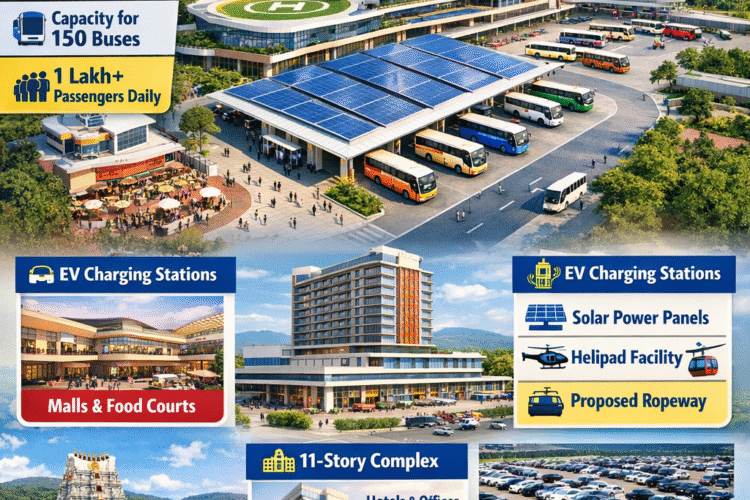
- Tirupati’s Upcoming Ultra-Modern Bus Stand: ₹500 Crore Intermodal Bus Terminal Project Announced
- Sri Valli Devasena Sametha Subramanya Swamy Devasthanam – Vallimalai
- IBO Stores Opening Soon in Tirupati – Two New Locations Announced
- Commercial Property Options via My Tolet India (Hyderabad)