Historic India-EU Free Trade Agreement: A New Era in Global Trade
India-European Union partnership — especially the historic India-EU Free Trade Agreement (FTA) concluded on 27 January 2026.
New Delhi, India — In a landmark development that economists are calling the “mother of all trade deals,” India and the European Union (EU) have finalized a comprehensive Free Trade Agreement (FTA) after nearly two decades of negotiations. The pact — formally agreed in New Delhi — aims to open markets, reduce tariffs on most goods, and elevate economic cooperation between two of the world’s largest economic blocs.
The FTA covers nearly 25 % of global GDP and about one-third of world trade, linking India’s 1.4 billion market with the EU’s 27 member states and a combined population of around 2 billion consumers.
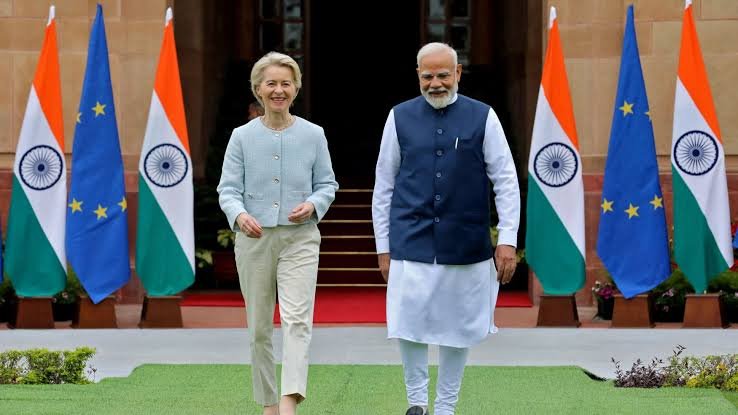
Prime Minister Narendra Modi, European Commission President Ursula von der Leyen, and European Council President António Costa announced the conclusion of the deal during the 16th India-EU Summit in New Delhi, underscoring the strategic importance of this partnership.
Key Features of the India-EU FTA
📦 Tariff Reductions and Market Access
The deal will slash or eliminate tariffs on the vast majority of traded goods — 96.6 % of EU exports to India and 99 % of Indian exports to the EU on a value basis.
Indian tariffs on EU automobiles will be gradually reduced from as high as 110 % to around 10 % over time, making luxury and premium European cars more accessible in India.
Sensitive agricultural products like rice, dairy and beef are mostly excluded, balancing domestic interests with trade liberalization.
🌍 Services, Investment, and Mobility
Beyond goods, the FTA includes services commitments, opening access in sectors such as IT/ITeS, professional services, education, financial services and tourism — with 144 service sub-sectors on India’s side benefiting from greater EU market access.
The pact also paves the way for business mobility frameworks, facilitating movement of professionals, intra-corporate transferees, and contractual service suppliers.
🔌 Strategic and Regulatory Cooperation
Negotiators agreed on deeper cooperation on maritime security, counter-terrorism, cybersecurity and defence technology co-development.
A pilot EU Legal Gateway Office in India aims to help businesses navigate regulatory and legal frameworks for smoother cross-border trade and investment.
Economic Impact and Growth Potential
According to official estimates, exports worth around ₹6.4 lakh crore (USD ~75 billion) stand to benefit from preferential access to the EU’s vast consumer and industrial markets. Indian labour-intensive sectors — like textiles, apparel and seafood — could see significant growth as tariffs on key products are eliminated.
Commerce Minister Piyush Goyal noted that the FTA could transform India’s textile exports from about USD 7 billion currently to USD 30–40 billion, creating 6–7 million new jobs in the sector.
Top Business Opportunities from the India-EU FTA
🧵 Textiles & Apparel
Immediate zero duty on Indian textile and garment exports into the EU boosts competitiveness against regional rivals.
Major textile clusters (e.g., Tirupur, Surat) can scale up exports, integrate with European fashion brands, and pursue joint design partnerships.
👞 Leather & Footwear
Tariff elimination on leather goods opens access to the EU’s ~$100 billion footwear market.
Opportunities are ripe for upgrading production quality and design, enabling “Made in India” premium brands.
💎 Gems & Jewellery
100 % duty-free access gives Indian jewellers a competitive edge in EU luxury markets valued at ~$79 billion.
🐟 Marine & Agriproducts
Marine products, especially shrimp and processed seafood, benefit from tariff relief, expanding exports into Europe’s $53.6 billion marine market.
🧪 Engineering & Industrial Goods
Preferential access to the EU industrial market (estimated at ~$2 trillion) can drive exports of machinery, chemicals and electronics.
💻 Services & Professionals
IT and business services providers can leverage broader access to EU markets while seeking collaborative R&D and digital governance projects.
Mobility frameworks enable Indian professionals to work on EU contracts with greater ease.
⚡ Green Energy & Sustainability
EU commitments in green and sustainable development offer opportunities in renewable energy projects, battery tech, and climate-friendly solutions.
🚢 Supply Chains and Logistics
Exporters and manufacturers can optimize supply chains by sourcing cheaper European inputs (e.g., machinery, medical equipment), lowering production costs and improving global competitiveness.
What’s Next — Ratification and Implementation
While the political announcement has been made, formal implementation requires legal vetting and ratification by the European Parliament, EU member states, and the Government of India. Anticipated timelines suggest the deal may begin entering into force within the next year.
Conclusion — A Win-Win Strategic Partnership
The India-EU Free Trade Agreement is not just a trade pact — it is a strategic milestone that deepens economic ties, reduces dependence on traditional markets, and expands growth horizons for businesses on both sides. From manufacturing-led exports and services expansion to technology cooperation and sustainable development, the agreement sets a transformative agenda for the next decade.

- Upcoming Real Estate Projects in Tirupati 2026 | New Launch Flats, Villas & Plots
- Tirupati’s Upcoming Ultra-Modern Bus Stand: ₹500 Crore Intermodal Bus Terminal Project Announced
- Sri Valli Devasena Sametha Subramanya Swamy Devasthanam – Vallimalai
- IBO Stores Opening Soon in Tirupati – Two New Locations Announced
- Commercial Property Options via My Tolet India (Hyderabad)